
Weird House Press (2022)
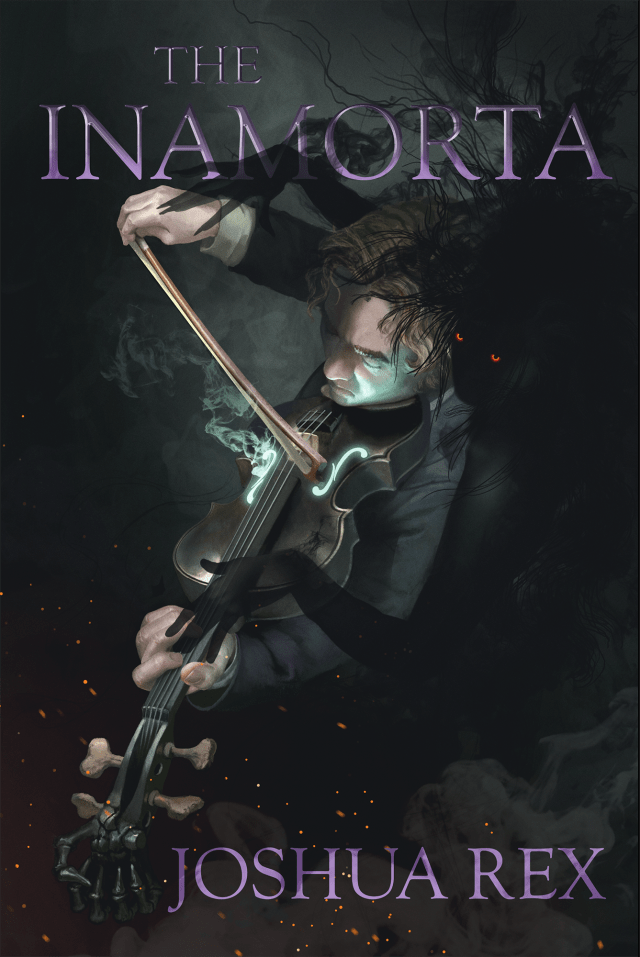
November, 1799. Jonas Layne, the acclaimed “world’s greatest violist” who performs on a notorious viola known as the Inamorta whose previous owners all have succumbed to violent fates, begins keeping a journal. He is weary of the touring life and plagued by a terrifying reoccurring nightmare of a monstrous wolf. When Jonas and his father/piano accompanist Theodore are commissioned by the enigmatic Count Rufus Canis, they travel to his residence, Teethesgate Castle, in the hinterland. Teethsgate is eccentrically opulent and grandiose, but things there are not as they seem. Something ghostly clings to the castle and its bizarre family. In Larmes Harbor, the decrepit village south of the castle, people are disappearing, and the Count’s seductive daughter, Daeva, has a fearful and powerful secret which will force Jonas to confront one of his own—and the reality that his nightmare might be more premonition than dream.
Available in Paperback and eBook here, and Signed and Numbered Hardcover here.
“Joshua Rex continues to demonstrate why he is one of the most dynamic young writers in the weird fiction field. The Inamorta is a splendid example of old-time Gothicism – a Golgotha of horror and grue livened with deft character portrayal and crisp narrative pacing. And in its attempt to achieve the supremely difficult task of evoking terror from music, it is a thunderous success.”
– S. T. JOSHI
“In The Inamorta, Joshua Rex blends classic Gothic imagery and adept storytelling that evokes beauty and a creeping sense of dread. Rex’ writing is poetic and stylish, his character portrayal and narrative are clever, and his use of allusion, bits of well-balanced humor, music, and a bad-ass wolf make The Inamorta a rare and wonderfully crafted novella.”
– JOHN MCILVEEN, Stoker-nominated author of Hannahwhere and A Variable Darkness
“Joshua Rex’s writing is haunting, evocative, and intelligent. The Inamorta is a masterpiece of introspective horror, rich with characterization and atmosphere. Rex manages to capture the essence and feel of the best gothic literature while overlaying it a counterpoint of modern accessibility.”
– CURTIS M. LAWSON
The Story of the Endpapers for THE INAMORTA
I’ve always wished I were a trained musician. Some kids are forced to take years of piano lessons—I wanted to be one of those kids, but alas it wasn’t in the family budget. I wrote songs in my teens, took violin lessons and taught myself piano fundamentals in my twenties. Somewhere along the line I fell in love with the viola, and obsessively sought out music written for it. The solo works in particular are some of the most emotive and powerful written for any viol family instrument (see Vieuxtemps “Capriccio,” and Britten’s “Elegy”). In the latter, the wordless yearning is so similar to a human’s mourning wail that it is easy to forget it’s coming from a box of wood and strings.
I was greatly influenced by this notion while writing The Inamorta. In it, Jonas Layne’s eponymous instrument sounds so close to the human voice that it’s uncanny (the reason for this, of course, later becomes apparent). While working on the novella, I often wondered what the viola would sound like; as a result, a song began to develop in my mind. The nascent theme grew in complexity and length as I revised the book, and after a while the piece became so integral to the story I knew I had to include it.
But how? I thought if I transposed the piece to guitar or piano I could ask a violist to perform it, but I couldn’t find one. Fortunately, however, I had made friends with S. T. Joshi—the preeminent scholar, author, and also accomplished musician. S.T. did editorial work on The Inamorta and was well acquainted with the story. So I pitched him a crazy idea: If I recorded myself humming the piece, could he transpose it music? To my surprise, he was willing to give it a try, and less than a week later I received not only sheet music for the piece but a viola simulation performance of it (which was 95% close to the music in my head). Hearing what had to that point been only in my head was an astounding moment.
The sheet music enabled me to create a faux musical “score” for the composition (entitled “Melania’s Solo”). I had spent a good deal of my late twenties and early thirties as an artist, and produced a series of reproduced historical documents called Primary Sources. Most of these were sheets of paper with letters or musical notes drawn in brown pen and ink, and then stained with tea; I utilized the same process to create the score.
The endpapers for The Inamorta are, for me, sort of a miracle. They are the fulfillment of a long desire to compose music for an instrument I love but cannot play. They give aural agency to the frightful instrument in the story. They are a testament to true collaboration (without S.T.’s help they wouldn’t exist). Finally, they are the intersection point of the work I’ve done as a songwriter, artist, and author.

Photograph of the original artwork by Joshua Rex for “Melania’s Solo,” written by Joshua Rex and transcribed by S. T. Joshi.
 JOSHUA REX